What is toneScan?+
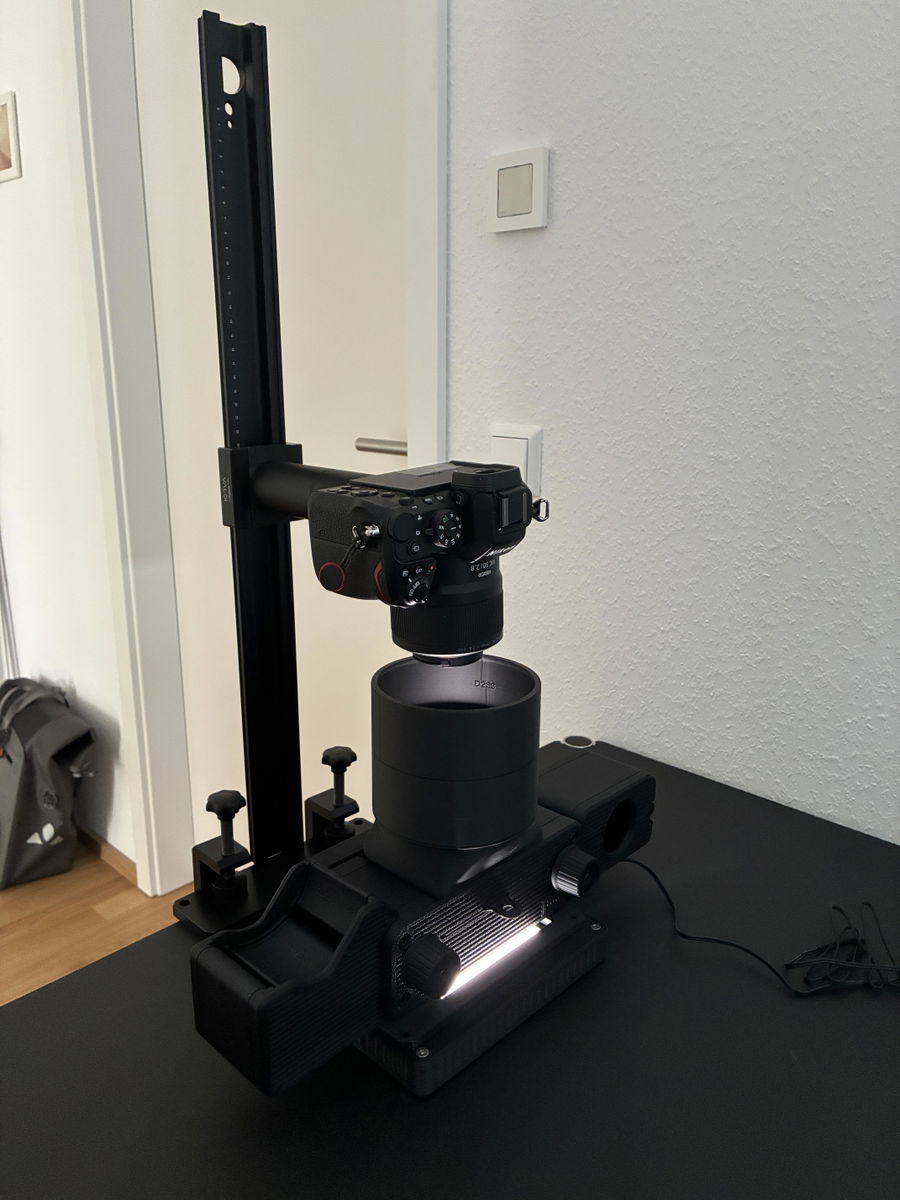
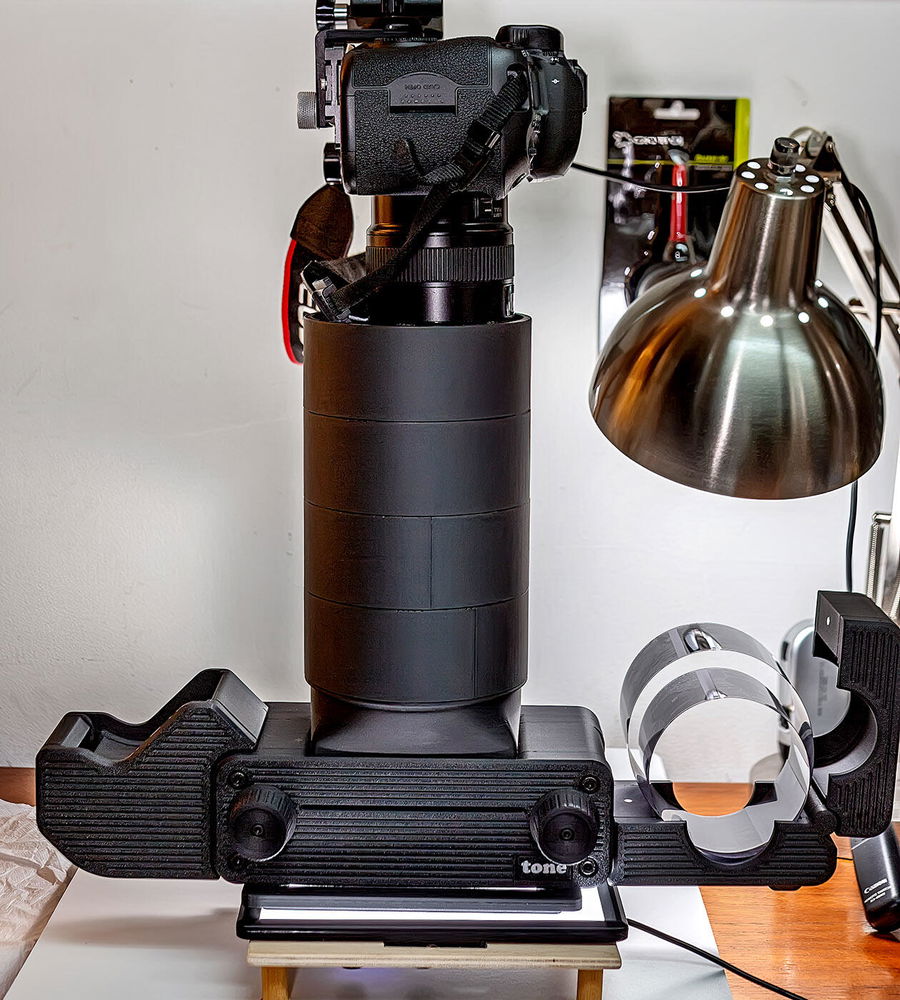
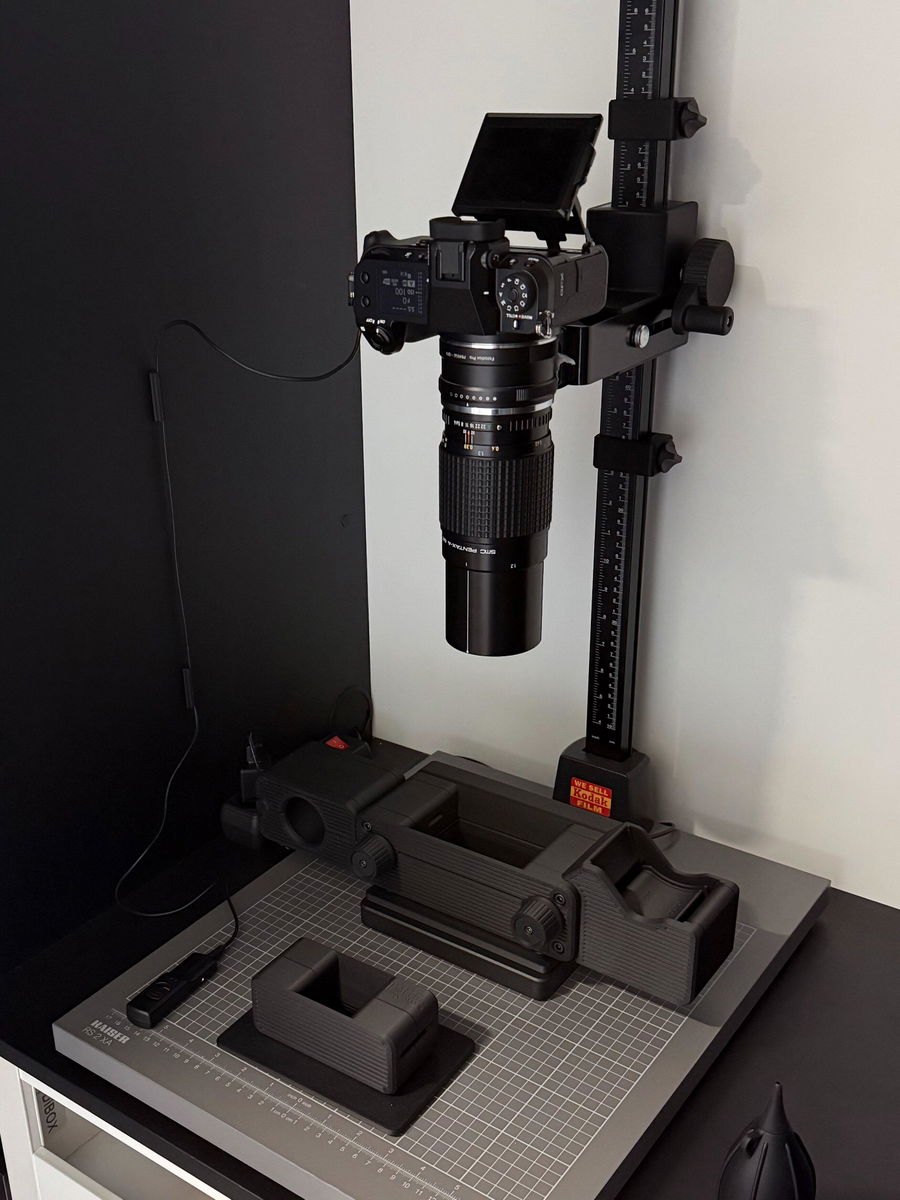
toneScan is a film scanning system for digital cameras. It combines the toneLight RGB light, the motorised toneCarrier film holder and the toneScan Studio software, so digitising film with your camera is fast and effortless.
What is toneLight?+
toneLight is our light panel made specifically for film scanning. Its red, green and blue LED arrays are picked for the best channel separation with colour negative film. It also has a 95 CRI white panel for slides and black and white film, and an 880 nm infrared panel for dust reduction with compatible cameras.
What is toneCarrier?+
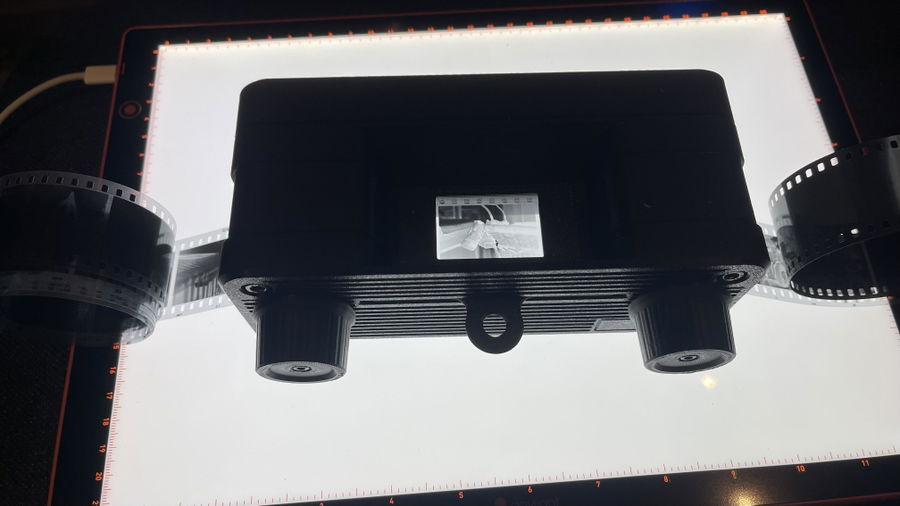
toneCarrier is our film holder for 35 mm and 120 film, used by thousands of photographers around the world. The motorised version feeds and advances the film for you, and any existing toneCarrier can be upgraded to it in less than 5 minutes.
Why scan film with a camera?+
A digital camera with the right light and film holder gives results comparable to a lab scanner, often with more resolution and flexibility, using gear you may already own. toneScan uses the same technique as lab scanners, separate red, green and blue exposures, and automates the rest, so a full roll takes about two minutes.
What do I need?+
A camera with a standard remote shutter input, a copy stand or sturdy tripod, and a computer running macOS or Windows if you want Studio (you don't strictly need it). If you already camera-scan with a toneCarrier, start with the light: you have everything else.
What is Kickstarter?+
Kickstarter is a crowdfunding platform. You back a project by pledging for one of its rewards, and your card is only charged if the project reaches its funding goal by the end of the campaign. Our campaign will help us raise funds for the final prototyping, manufacturing and certification of toneScan.
I backed the first campaign. What happened to my pledge?+
Kickstarter is all or nothing, so your pledge ended with the first campaign. To back this one, you pledge again. Nobody who comes back pays more than they did the first time.
Why is it cheaper now?+
The first campaign had to pay for injection-mould tooling and a batch of 250 lights before a single one shipped. This time the first batch is smaller, in 3D-printed housings, so there's no tooling cost in the goal. The light and the electronics inside are the same.
Is a 3D-printed housing as good as a moulded one?+
It's printed in HP Multi Jet Fusion PA12 nylon, which is used for end-use parts in cars and industrial equipment. It's tough, and the light, electronics and aluminium base inside are the same. The surface is a fine-grained matte, a little rougher to the touch than smooth moulded plastic. Every toneLight in our photos and videos already has an MJF housing, so what you see is what you get. If we reach £50,000, everyone gets the moulded ABS housing instead.
What's the stretch goal?+
At £28,000 we build the first batch of toneLights with MJF nylon housings. At £50,000 the pledges also pay for two steel injection moulds, and every backer's toneLight ships in moulded ABS. If we land somewhere in between, your toneLight ships in the printed housing, and we pay for the moulds from shop sales of the first batch, so the second batch is moulded.
What's the standalone Motor Kit?+
It motorises a manual toneCarrier you already own, 35 mm or 120. You connect it to your computer over USB. You can control it from toneScan Studio or from your own software through the open API. A free web app is on the way. It comes with the link cable for a toneLight, so you can add the light later. A Studio licence isn't included with the Motor Kit on its own; every reward with a toneLight includes one. You supply the USB-C charger and cable.
Does it work without a computer?+
Yes. The toneLight and the motorised carrier move the film, run the light and fire your camera from the front panel, saving straight to the camera's SD card. Full automation, with closed loop centring, needs Studio.
When will it ship?+
We're aiming to start shipping in February 2027. The order dates are in the timeline above.
When do I pay for shipping?+
Shipping isn't in your pledge. After the campaign you'll get a pledge manager link where you pay the actual shipping for your country: about £5–10 in the UK, £30–50 to the US and £25–35 to the rest of the world.
How will toneScan Studio be licensed?+
Every reward with a toneLight includes a lifetime licence: no subscription, and it covers two machines. After the campaign Studio will be sold separately, as a lifetime licence or a subscription.
Which cameras are supported?+
Any camera with a standard remote shutter input. toneLight triggers the shutter directly and never touches your exposure settings, so metering stays in your hands. All major brands.
How does it trigger the shutter?+
There is a 3.5 mm shutter release cable port which can trigger all popular cameras.
How is it powered?+
It runs on USB-C Power Delivery, so any PD charger or power bank of 40 W or more will do.
What are the LED wavelengths?+
Red: 650–670 nm
Green: 520–540 nm
Blue: 440–455 nm
White: 95 CRI, 5700 K
Infrared: 880 nm
Which film formats does it support?+
35 mm and 120, and motorised upgrades are available for both. Frame spacing can be set to any standard frame size or a custom one, and half-frame masks are available. The motor drive also makes automatic 6x17 capture possible: it takes two shots of each frame, which are then stitched together. 16 mm, 4x5 and 8x10 are not supported.
Does this even make sense on a non-monochrome camera?+
Yes, because by extracting only the relevant RGB channel from each single-colour capture, you are effectively simulating a monochrome camera with some reduction in resolution.
Would this work better with a monochrome camera?+
Yes, this is an ideal scenario, but it is not required to get excellent results. An advantage is that a monochrome/full spectrum sensor allows using the IR array for dust removal in software.
Is infrared dust removal supported?+
Yes, in beta. toneScan Studio uses the infrared channel when the scan has one, and finds dust in software when it doesn't. Infrared needs a monochrome or full-spectrum camera, because regular camera sensors have a built-in filter that blocks almost all infrared light.
How does it compare to a lab scanner?+
For most negatives, comparable, and better in resolution and flexibility. All this at a small fraction of the price of a 30-year-old machine.
What about slide film / E-6?+
toneLight has a high-CRI white mode for slides. Editing is supported in toneScan Studio, but slides are positive, so they can also be easily adjusted like normal photos in any editor.
How do you combine RGB captures?+
toneScan Studio does it for you. It captures and merges the RAW files from any camera, and exports them as JPEG or 16-bit TIFF. You can also combine them by hand in Photoshop.
Do I need toneScan Studio, or can I use other software?+
You don't need it. The hardware has an open API for other software, and a free web app for the light and the motor is on the way. Studio is where the files get processed: it merges and inverts the scans, runs full auto scanning, and handles editing and export. The three captures are standard RAW files, so you can also merge them yourself, and Studio exports the merged scan as TIFF or DNG for editing elsewhere.
How long does a roll take?+
In our tests a full 35 mm roll takes about 2 minutes to capture. Studio merges the scans as they arrive, so they're ready to look at when the roll finishes.